
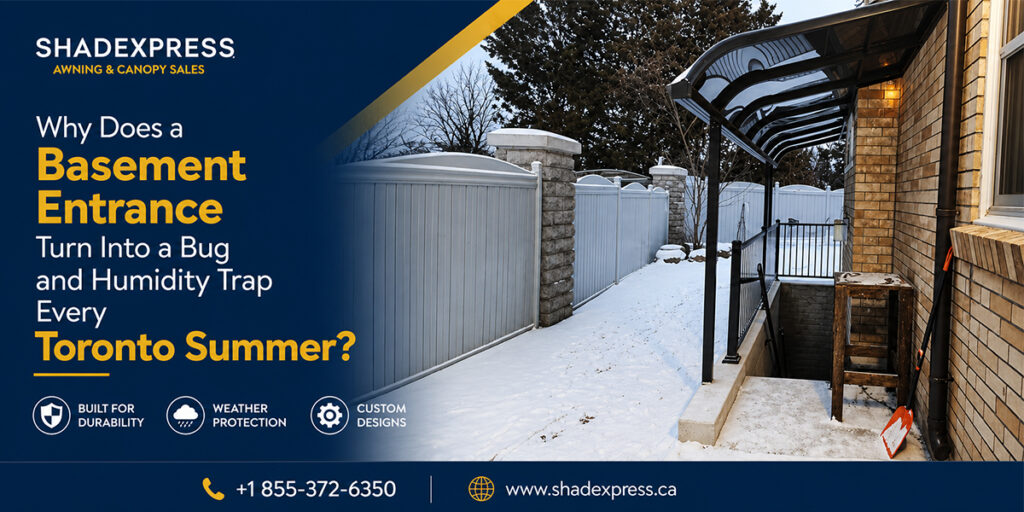
An open basement stairwell traps warm, damp air against the door, with nowhere to escape. Summer humidity settles into that low, shaded space faster than it clears. Bugs follow the moisture, and an uncovered entry gives them an easy path straight to your basement door.
Why Does Humidity Build Up So Fast in an Open Stairwell?
A below-grade stairwell sits lower than the surrounding yard. Warm air holds more moisture in summer, and that moisture sinks into low, shaded spaces first. Without airflow or a barrier, humid air collects against the basement door.
Over time, that trapped moisture can create a musty smell near the entrance. It also creates ideal conditions for mildew to form on concrete steps and walls.
What Draws Bugs to an Uncovered Basement Entrance?
Insects prefer wet, shady, and sheltered locations, and a stairwell provides all three. Ants, spiders, and other insects usually make their nests in the spaces between the steps and walls. With an uncovered entrance, there will be even more hiding spots for the bugs since leaves and other litter accumulate.
Every time the basement door opens, insects near the threshold have a direct path into the basement. A fully open stairwell makes it nearly impossible to control access at that point.
How Does a Custom Basement Enclosure Solve Both Problems?
Custom basement enclosures Toronto homeowners install fully close off the stairwell instead of just covering the top. The enclosed structure blocks humid outdoor air, direct sun, and pest access at the source. These enclosures have durable metal framing with a powder-coated finish. This holds up to Toronto’s summer heat and humidity.
Because the space is sealed rather than open, moisture has far less opportunity to settle near the door. Debris and insects also lose easy access to the steps and walls below.
Why Should Enclosures Be Custom-Fitted for Residential Basements?
Each basement entrance is different in depth, width, and slope. A standard enclosure often leaves gaps at the edges, letting in humid air and bugs. Residential basement enclosures are built to match the exact stairwell, completely closing gaps and keeping the space properly sealed.
A custom fit also allows for proper ventilation planning. This keeps the enclosed space from trapping moisture instead of keeping it out.
Conclusion
Summer humidity and pests do not have to keep finding their way into your basement stairwell every year. Sealing that entrance with a properly fitted structure removes what draws both moisture and insects in the first place. If your entryway feels damp or buggy by midsummer, a fully enclosed design might be worth a look. It’s a small change that can make a real difference before the next heat wave hits.
FAQ’s
Will a basement enclosure make my stairwell too humid inside?
A well-designed enclosure is planned with airflow in mind, not sealed like a sealed box. Custom Basement enclosures Toronto contractors build typically include ventilation options that prevent trapped moisture. This keeps the space dry without letting outside humidity back in.
Can a basement enclosure help with bug problems specifically?
Yes, sealing the stairwell removes the shaded, damp entry point that insects use. It will not get rid of every pest around your home, but it blocks one of the main ways they get in. For best results, combine this with regular yard maintenance.
How long does a basement enclosure installation take in Toronto?
Most residential basement enclosures projects are finished within a few weeks after the first design meeting. The exact timing depends on the size of your stairwell, the materials you choose, and how easy it is to access the site. Custom fabrication may take a bit longer, but it makes sure the fit is perfect and gap-free.